
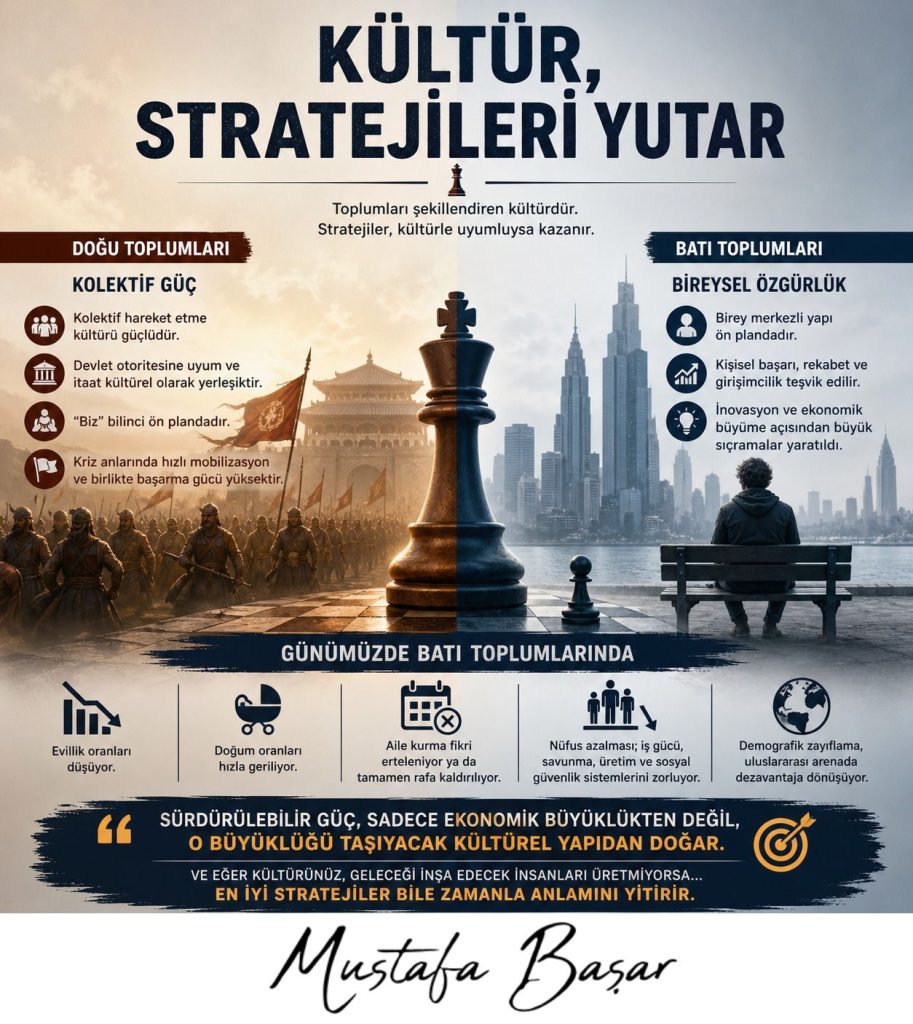
The saying attributed to management guru Peter Drucker, “Culture eats strategy for breakfast,” is one of the most famous maxims in the business world. It conveys that no matter how perfect, logical, or brilliant an organization’s strategies may be, if those strategies are not aligned with the company’s existing culture (the beliefs, habits, and behaviors of its employees), they are bound to fail.
Just as in companies, there is a reality that also applies to societies: even the best-written strategies fail if they are not aligned with the culture in which they operate. From a historical perspective, Eastern societies have a much stronger culture of collective action. Alignment with state authority, the instinct to act together, and a strong sense of “we” have formed the foundation of economic and social order for centuries. This structure has provided a significant advantage in terms of rapid mobilization and orientation toward common goals during times of crisis.
Western civilizations, on the other hand, have built a more individual-centered structure, especially with the development of the capitalist system. Individual freedoms, personal achievement, and competition have become the driving forces of economic growth. This model has led to major breakthroughs in innovation and entrepreneurship. However, at the point we have reached today, the differences between these two approaches have begun to create a new fracture.
In Western societies, individualism has in many cases evolved into “excessive individualism.” Even though people have more freedom, wealth, and comfort, marriage rates are declining, and birth rates are rapidly falling. The idea of starting a family is being postponed or completely set aside.
This is not only a sociological shift, but also a strategic risk.
Because population decline directly affects many areas from labor force and defense capacity to production and social security systems. Today, many developed countries, despite being economically strong, are experiencing demographic weakening. On the other hand, societies where collective culture remains strong tend to create a different long-term advantage through younger population structures, higher birth rates, and more resilient social bonds.
The reality is that sustainable power is not driven only by economic size, but also by the “cultural structure” that supports and carries that size. And if your culture is not producing the people who will build the future, even the best strategies will eventually lose their purpose and meaning.
I look forward to your responses, opinions, and thoughts with curiosity.
Do you think strategy shapes culture, or does culture determine strategy?
Best regards,
Mustafa BAŞAR