
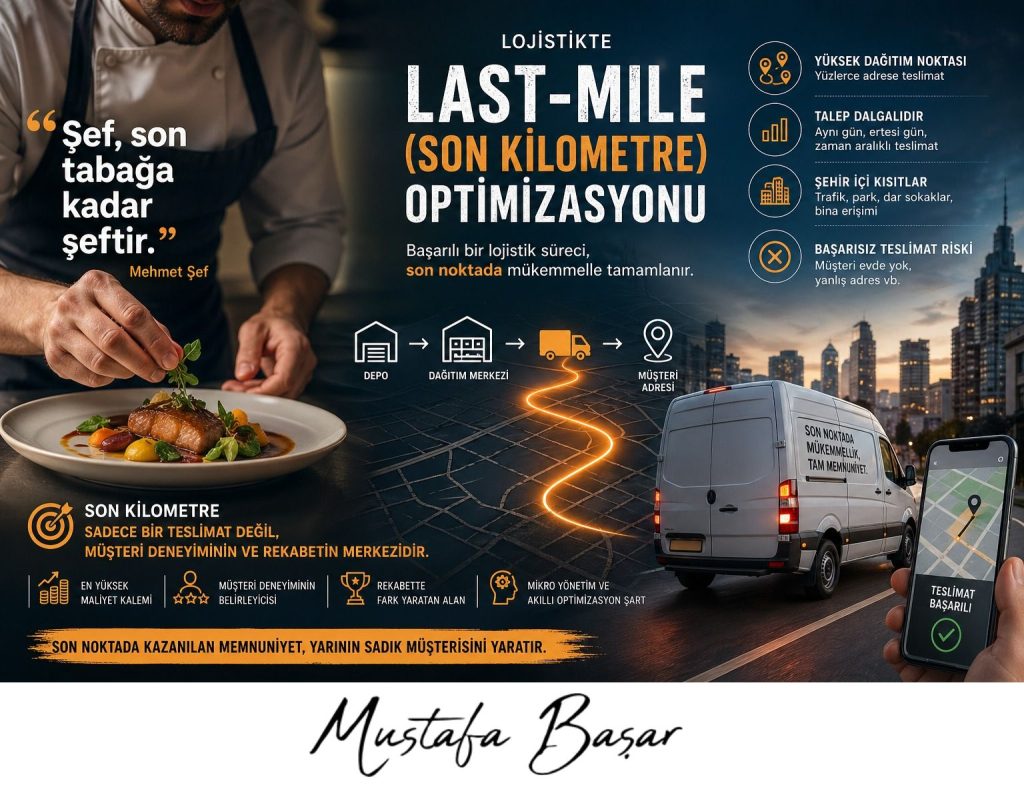
I have followed the long-running MasterChef Türkiye program over the years whenever I had the chance to watch it. Among all the episodes I have seen, the most memorable and key statement for me came from Chef Mehmet: “A chef is a chef until the last plate.”
I think this perfectly expresses the consistency, discipline, and obligation to deliver the best at every moment that must exist in a kitchen. After all, a chef’s past achievements may certainly make them popular, but speaking sincerely from my own perspective: I judge the plate that has been served to me, the one right in front of me. If the presentation and the flavor do not satisfy me, what should I do with the chef’s past accomplishments or popularity?
The concept of Last-Mile, which refers to the process of “delivering products from the distribution center to the end consumer,” is very similar to the idea expressed in the phrase “A chef is a chef until the last plate.” The final stage of the entire logistics process—reaching the last destination or the individual customer—is in fact the most costly and one of the most critical operations. Especially in e-commerce logistics, it has become one of the most strategic and critical issues of the past decade, representing the area where companies have the greatest opportunity to differentiate themselves in competition.
Why is the last mile so important?
The last mile is the final link of the supply chain: warehouse → distribution center → customer address. However, this short distance is operationally the most complex part because:
– The number of delivery points is extremely high (hundreds of addresses instead of a single truck delivery).
– Demand is highly variable (expectations for same-day, next-day, or time-window deliveries).
– There are urban constraints (traffic, parking, narrow streets, and building access challenges).
– The risk of failed deliveries is high (customer not being home, incorrect address, etc.).
The last mile should no longer be viewed merely as the largest cost element; it has become the center of customer experience and competition. As a result, it requires much more “micro-management” than traditional logistics optimization. I recommend that all companies in our country involved in the sale and distribution of food and fast-moving consumer goods closely monitor and analyze the last-mile strategies and competitive dynamics of players such as Trendyol, Hepsiburada, and Getir within their respective regions. Because I believe that in the near future, simply performing basic route optimization and smart route planning for field sales representatives engaged in hot sales will no longer be sufficient.
Best regards,
Mustafa BAŞAR