
Author: Mustafa BAŞAR
Management Consultant
Georgia plays a key role in the Middle Corridor
As a businessperson, while fulfilling my current managerial responsibilities and also engaging in various social responsibility activities, I constantly meet different people. For me, every person represents a different story, which is why I value new encounters; of course, I also meet people outside the business world who leave a lasting impression on me. One such person is Mr. Aleksandre Jishkariani, who serves as the Consul General of a foreign state in Istanbul, one of the most important cities in our country. He has left a strong impression on me with both his sincerity and his expertise. He is a highly respected diplomat with more than 23 years of experience at the Ministry of Foreign Affairs of Georgia.
The history of the Georgian people dates back to the 12th century BC, with a deep-rooted past, a culture shaped by the adoption of Christian in 337 AD, and a golden age during the 11th and 13th centuries, when a powerful kingdom emerged in the Caucasus. In particular, I consider the Battle of Didgori and the later period of Queen Tamar of Georgia to be highly significant symbols in Georgian history. As is well known, in Turkish history there was also a female leader who lived 1,500 years before Queen Tamar of Georgia: Tomyris. Although they lived in vastly different eras, I believe both female leaders shared important common traits and conveyed significant messages to their societies, particularly to men. Even today, when many states and companies still lack sufficient female representation in leadership roles and the principle of inclusivity is not yet fully realized, the Georgian ruler Queen Tamar of Georgia governed her country more effectively than many of the kings of her time, nearly nine centuries ago. After centuries of influence and conflict involving the Iranian, Ottoman, and Russian empires, Georgia regained its independence on April 9, 1991, following its departure from the Soviet Union. I believe it is now one of the most important pillars of stability in the Caucasus region. Through the development of economic relations both with our Turkic neighbors such as Turkey and Azerbaijan, as well as with our other neighbor Armenia, all four countries in the region could achieve a far stronger position on the international stage.
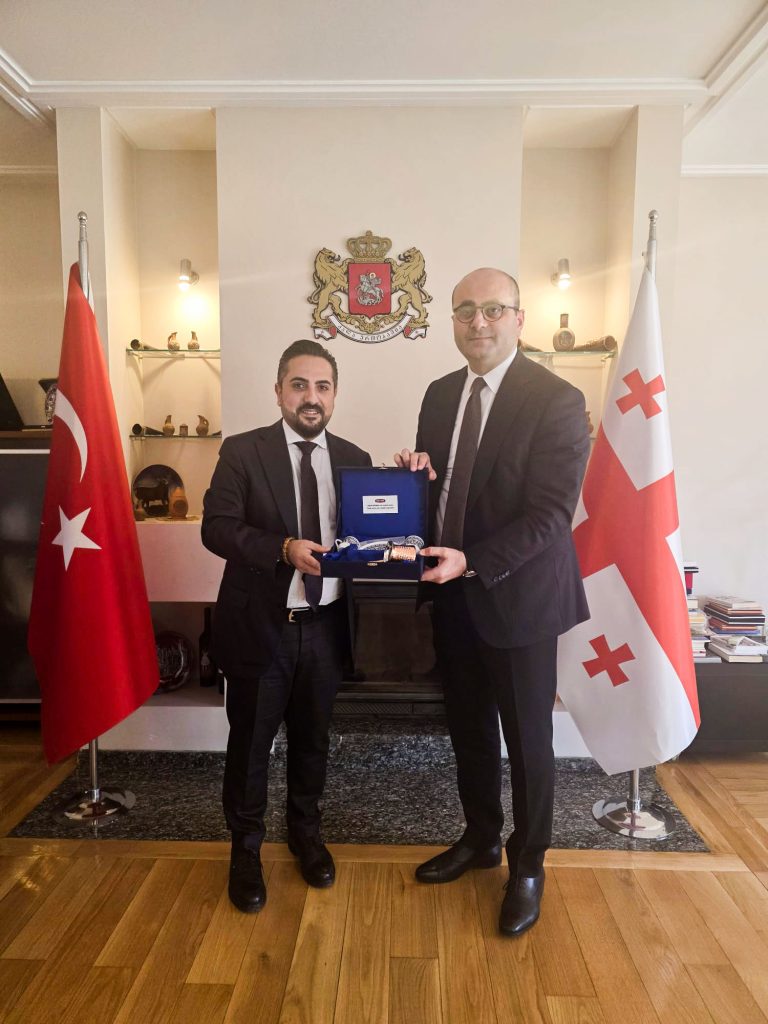
We had the opportunity to meet on different platforms before, and I visited Mr. Aleksandre Jishkariani, with whom we had a very productive conversation. I am sharing his remarks exactly as he conveyed them during our discussion.
The logistical importance of Georgia has significantly increased in today’s geopolitical environment. Historically, the country has served as a crossroads between Europe and Asia; however, recent shifts in global supply chains and regional geopolitical developments have further strengthened Georgia’s strategic role. In 2024, bilateral trade volume between Georgia and Turkey reached 3.233 billion USD, marking a 16.2% increase compared to the previous year. In the first ten months of 2025 alone, trade volume has already reached 2.536 billion USD. Turkey remains Georgia’s largest trading partner, highlighting the strategic importance of economic cooperation between the two countries.
Georgia is one of the key countries in the Middle Corridor (the Trans-Caspian International Transport Route), which connects East and Central Asia to Europe via the South Caucasus and Turkey. Today, this corridor is increasingly gaining importance as one of the most efficient and secure alternative routes for trade flows between Europe and Asia. In this context, infrastructure projects such as the Baku–Tbilisi–Kars railway have played a critical role, providing a direct rail connection between the Caspian region and the Turkish and European markets.
Georgia’s government is also making large-scale investments in transport infrastructure. These include the development of the East–West highway, the modernization of the railway system, the expansion of Black Sea ports, and the Anaklia Deep Sea Port project. In total, investments in transport infrastructure amount to approximately 7 billion USD. Georgia’s Black Sea ports, together with its modern transport network, form an integrated multimodal logistics platform that combines maritime, rail, and road transportation. For this reason, Georgia is not only a neighboring market for Turkish companies, but also a regional logistics hub providing access to Central Asia, the South Caucasus, the Black Sea region, and European markets. At a time when global supply chains are increasingly under pressure due to geopolitical uncertainties, stability, openness, and predictability have become key competitive advantages, and Georgia offers precisely these conditions to its international partners.
Georgia offers one of the most liberal and transparent investment environments in the region. The country’s economic policy is strongly focused on supporting business development and attracting foreign investment. Georgia’s tax system is among the most competitive in the region. Companies benefit from a 15% corporate tax applied only to distributed profits, while profits reinvested into the business are not taxed. This system, often referred to as the “Estonian model,” allows companies to reinvest more resources into expanding their operations and increasing production capacity. Another important advantage is a fully digital and simplified tax administration system, which significantly reduces bureaucratic procedures. Investors can also benefit from Free Industrial Zones (FIZ) located in Tbilisi, Kutaisi, and Poti. Companies operating in these zones benefit from the following incentives:
o 0% corporate tax on export-oriented production
o VAT and customs duty exemptions
o Simplified administrative procedures
Access to international markets is equally important. Georgia has free trade agreements with the European Union, Turkey, China, EFTA countries, CIS countries, the United Kingdom, and many other partners. These agreements provide duty-free access to more than 2.3 billion consumers. As a result, establishing production or packaging operations in Georgia enables Turkish companies not only to serve the domestic market, but also to export to Europe and Central Asia with significant customs advantages. Investment trends also confirm the strong interest of the Turkish business community in Georgia. In 2024, foreign direct investment originating from Turkey reached approximately 110 million USD, while in the first two quarters of 2025 this figure amounted to 81.44 million USD. As of January 1, 2025, the number of active companies with Turkish capital operating in Georgia reached 2,747, reflecting a high level of trust and a long-term partnership between the business communities of the two countries.
Georgia’s economy has a diversified structure and demonstrates strong and sustainable growth performance. The main drivers of economic growth include services, energy, transport and logistics, manufacturing, agriculture, and tourism. In recent years, the Georgian economy has followed a strong growth trajectory. In 2024, the average growth rate reached approximately 9.4%, while in 2025 the economy grew by around 7.5%. These rates are among the highest growth figures in the region. In particular, several sectors stand out: the manufacturing industry is a priority area, especially in the production of components for the electronics, automotive, and aviation sectors. The pharmaceutical and biotechnology sectors are also developing rapidly, driven by increasing demand for both generic and innovative medicines.
Logistics and transport infrastructure represent another critical area. Georgia’s role as a regional transit hub offers significant opportunities for the development of modern logistics centers and warehousing facilities. Renewable energy is also a major area of potential. Georgia is rich in hydropower, wind, and solar energy resources, providing attractive opportunities for new energy projects.
Finally, information and communication technologies (ICT) and digital services are growing rapidly, supported by favorable tax policies and a skilled workforce. International companies such as Majorel, Concentrix, EPAM Systems, Viber, Godel Technologies, and Girteka are already operating in Georgia.
Key areas where Turkish premium and innovative brands stand out include:
o Smart construction technologies
o Furniture and interior design
o Pharmaceutical and medical products
o Renewable energy technologies
o Modern urban infrastructure solutions
Direct export can be an effective way to test a new market. However, companies that view Georgia not only as a market but also as a regional operational hub generally benefit more from local partnerships and joint ventures. Local partnerships enable companies to better understand market dynamics, develop localized services, and integrate into regional supply chains. A good example of this approach is Turkish construction companies that have carried out projects exceeding 5.6 billion USD in Georgia. This clearly demonstrates that a long-term local presence often leads to more sustainable success.
Successful Turkish companies in Georgia generally share the following core characteristics: a long-term strategic perspective, the ability to adapt to the local market, and effective cooperation with local partners. Another important factor is the integration of the local workforce, along with a strong commitment to high quality standards and transparent business practices. Companies that invest not only in sales but also in local production and services tend to achieve more sustainable results. From the perspective of Georgian consumers, Turkish products have long been associated with accessibility, reliability, and a strong price–performance balance. In recent years, interest in Turkish premium brands has also increased, particularly in sectors such as furniture, textiles, construction materials, and home appliances.
The South Caucasus and the Black Sea region still hold significant and largely untapped potential in terms of economic and cultural cooperation. The key areas of economic opportunity include:
o Energy transport and renewable energy projects
o Development of the Middle Corridor
o Establishment of regional logistics hubs
o Expansion of digital and telecommunications infrastructure
An important step in strengthening bilateral economic relations was the 6th meeting of the Turkey–Georgia Intergovernmental Commission on Economic Cooperation, held in Tbilisi on July 30–31, 2025. At this meeting, both sides reaffirmed their goal of increasing bilateral trade volume to 5 billion USD in the coming years. Direct engagement between the business communities also plays a crucial role. In 2025, two high-level business forums were organized with the participation of Georgian and Turkish companies, further strengthening private sector ties. Beyond economic cooperation, cultural and people-to-people relations also play a critical role. The growth of tourism, along with educational and cultural exchange programs, continues to deepen mutual understanding between our societies.
I believe that the strong political partnership between Georgia and Türkiye, together with their geographical proximity and economic complementarity, will further advance cooperation between the two countries in the coming years.